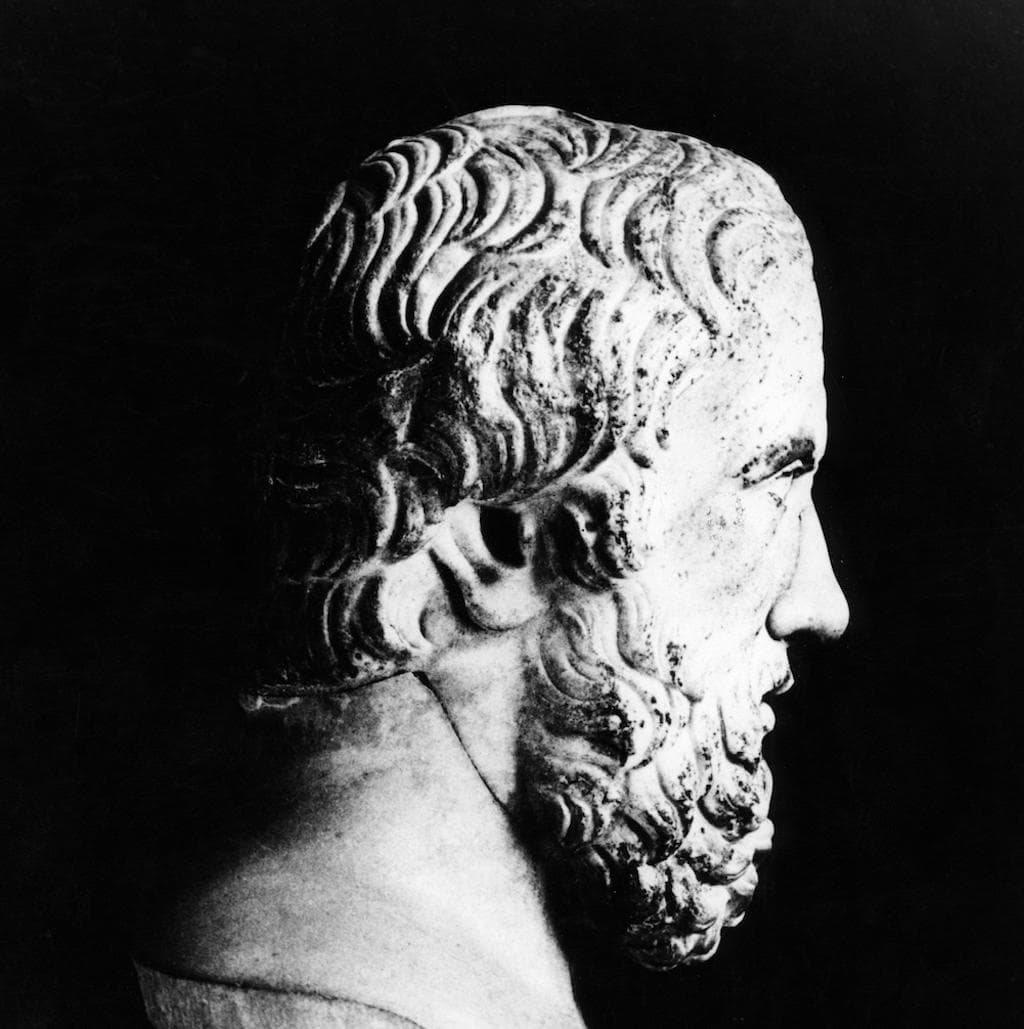
The only good is knowledge, and the only evil is ignorance.
Herodotus
Herodotus (c.484 BC -c.420 BC) is often called the "Father of History," and is the earliest, and one of the greatest of the ancient Greek prose writers. In most instances, his account is the only substantial one that survives of many key historical events.
Herodotus was an ancient Greek historian who lived c.484 BC – c.420 BC. He was born in Caria, Halicarnassus (modern day Bodrum, Turkey). He is regarded as the “Father of History” in Western culture, and was the first historian known to collect his materials systematically, test their accuracy to a certain extent and arrange them in a well-constructed and vivid narrative.
He is exclusively known for writing The Histories, a record of his research into the origins of the Graeco-Persian Wars which occurred in 490 and 480-479 BC. His writing includes a wealth of geographical and ethnographical information in a narrative account of that period, which would otherwise be poorly documented. There are many long digressions concerning the various places and people he encountered during wide-ranging travels around the lands of the Mediterranean and Black Sea.
Although some of his stories were not completely accurate, he claimed that he was reporting only what had been told to him. It was conventional in Herodotus’s day for authors to ‘publish’ their works by reciting them at popular festivals. According to Lucian, the rhetorician and satirist, Herodotus took his finished work straight from Asia Minor to the Olympic Games and read the entire Histories to the assembled spectators in one sitting, receiving rapturous applause at the end of it. According to a very different account by an ancient grammarian, Herodotus refused to begin reading his work at the festival of Olympia until some clouds offered him a bit of shade, by which time however the assembly had dispersed.
Herodotus’s recitation at Olympia was a favourite theme among ancient writers and there is another interesting variation on the story to be found in the Suda, Photius and Tzetzes, in which a young Thucydides happened to be in the assembly with his father and burst into tears during the recital, whereupon Herodotus observed prophetically to the boy’s father: “Thy son’s soul yearns for knowledge”.
Intimate knowledge of some events in the first years of the Peloponnesian War indicate that Herodotus might have returned to Athens, in which case it is possible that he died there during an outbreak of the plague. Alternatively, he may have died in Macedonia after obtaining the patronage of the court there. Either way, there is nothing in the Histories that can be dated with any certainty later than 430 BC and it is generally assumed that he died not long thereafter, possibly before his sixtieth year.
Essential cookies enable basic functions and are necessary for the proper function of the website.
Name
Description
Duration
Cookie Preferences
This cookie is used to store the user's cookie consent preferences.
30 days
These cookies are used for managing login functionality on this website.
Name
Description
Duration
wordpress_logged_in
Used to store logged-in users.
Persistent
wordpress_sec
Used to track the user across multiple sessions.
15 days
wordpress_test_cookie
Used to determine if cookies are enabled.
Session
Statistics cookies collect information anonymously. This information helps us understand how visitors use our website.
Track user interactions on your site with to optimize engagement and conversions.
Name
Description
Duration
_monsterinsights_uj
Stores anonymized user navigation history on the website, including visited URLs, page titles, and referrer information. It helps site owners analyze user journeys for improved site experience and analytics.
365 days
Marketing cookies are used to follow visitors to websites. The intention is to show ads that are relevant and engaging to the individual user.
Facebook Pixel is a web analytics service that tracks and reports website traffic.