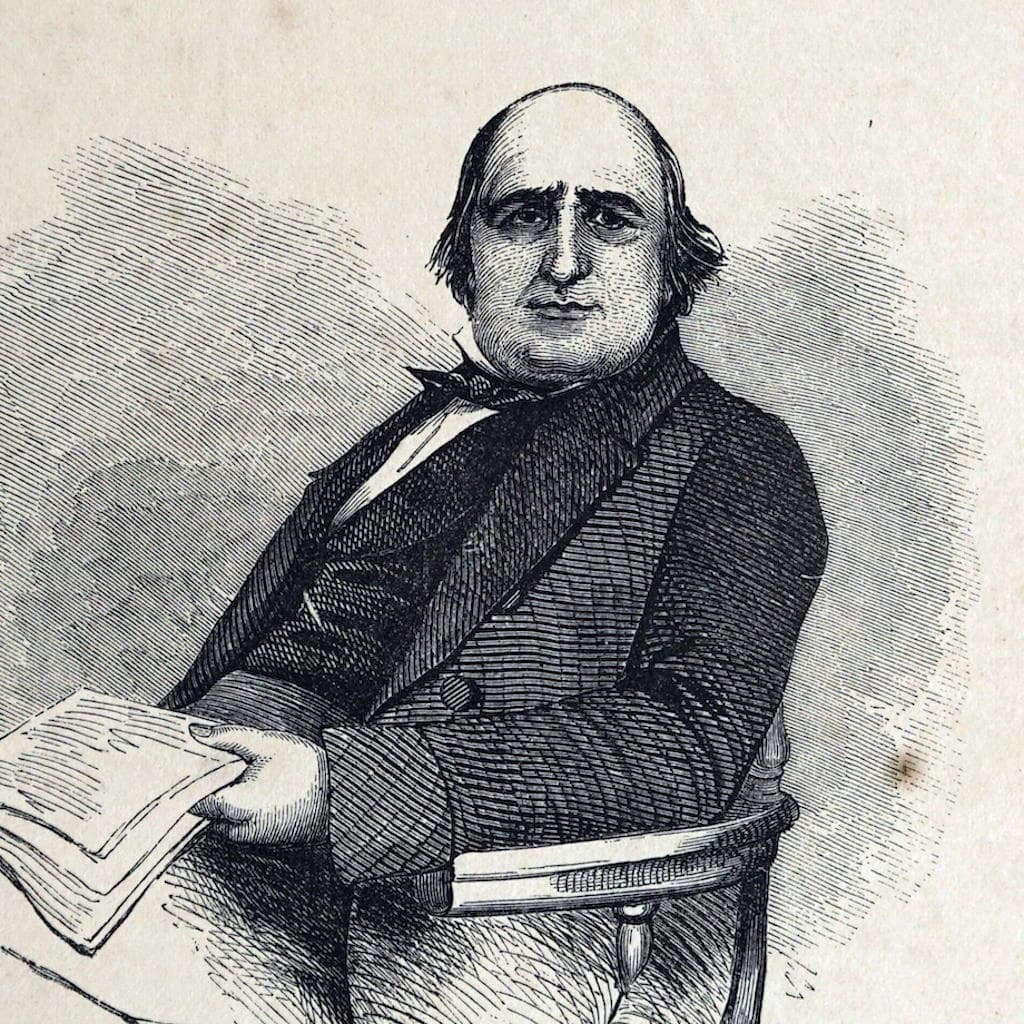
The essential quality of an animal is that it seeks its own living, whereas a vegetable has its living brought to it.

Henry Mayhew
Henry Mayhew (1812 - 1887) was a playright and journalist, and co-founder of 'Punch' magazine. He was a social reformer, and wrote a series of articles for 'The Morning Chronicle' on the plight of the poor on London's streets. These were later collected into a book, 'London's Labour and London's Poor', a detailed and extensive account of life as it truly was on the streets of Dickens' London.
Henry Mayhew was born on 25 November 1812 in London, one of seventeen children of Joshua Mayhew. He was educated at Westminster School, before running away from his studies to sea. He served with the East India Company as a midshipman on a ship bound for Calcutta, and returned after several years, in 1829, becoming a trainee lawyer in Wales. He left this to become a freelance journalist, contributing to The Thief, a readers’ digest. This was quickly followed by a play, Figaro, in 1829. Along with continuing to develop his writing, Mayhew briefly managed the Queen’s Theatre. Mayhew reputedly fled his creditors and holed up at The Erwood Inn, a small public house in the village of Erwood, south of Builth Wells, a town in mid Wales.
In 1835 Mayhew again found himself in a state of debt and, along with a fellow writer, he escaped to Paris to avoid his creditors. He spent his time writing and in the company of other writers, including William Thackeray and Douglas Jerrold. Mayhew spent over ten years in Paris, returning to England in the 1850s, where he became involved in several literary adventures, mostly the writing of plays. Two of his plays, But, However and The Wandering Minstrel were successful, while his early work, Figaro, when staged in London, was less so.
On 17 July 1841 Mayhew co-founded Punch magazine. At its founding the magazine was jointly edited by Mayhew and Mark Lemon. Initially it was subtitled The London Charivari, this being a reference to a satirical humour magazine published in France under the title Le Charivari, a work read often whilst Mayhew was in Paris. Reflecting their satiric and humorous intent, the two editors took for their name and masthead, the anarchic glove puppet, Mr. Punch. Punch was an unexpected success, and yet, a year later, Mayhew resigned.
In 1851 he published London Labour and the London Poor, a book that remains a landmark work of social journalism. For the first time, the realities of days spent struggling to make a living – not always legally – on the streets of London followed by nights spent crashed out in its cheapest, dirtiest boarding houses, were set out in great detail. In exposing such desperate people, blighted by disease, homelessness and unemployment, Mayhew provided real-life counterparts to the characters and stories of Charles Dickens, one of his great admirers.
Essential cookies enable basic functions and are necessary for the proper function of the website.
Name
Description
Duration
Cookie Preferences
This cookie is used to store the user's cookie consent preferences.
30 days
These cookies are used for managing login functionality on this website.
Name
Description
Duration
wordpress_logged_in
Used to store logged-in users.
Persistent
wordpress_sec
Used to track the user across multiple sessions.
15 days
wordpress_test_cookie
Used to determine if cookies are enabled.
Session
Statistics cookies collect information anonymously. This information helps us understand how visitors use our website.
Track user interactions on your site with to optimize engagement and conversions.
Name
Description
Duration
_monsterinsights_uj
Stores anonymized user navigation history on the website, including visited URLs, page titles, and referrer information. It helps site owners analyze user journeys for improved site experience and analytics.
365 days
Marketing cookies are used to follow visitors to websites. The intention is to show ads that are relevant and engaging to the individual user.
Facebook Pixel is a web analytics service that tracks and reports website traffic.