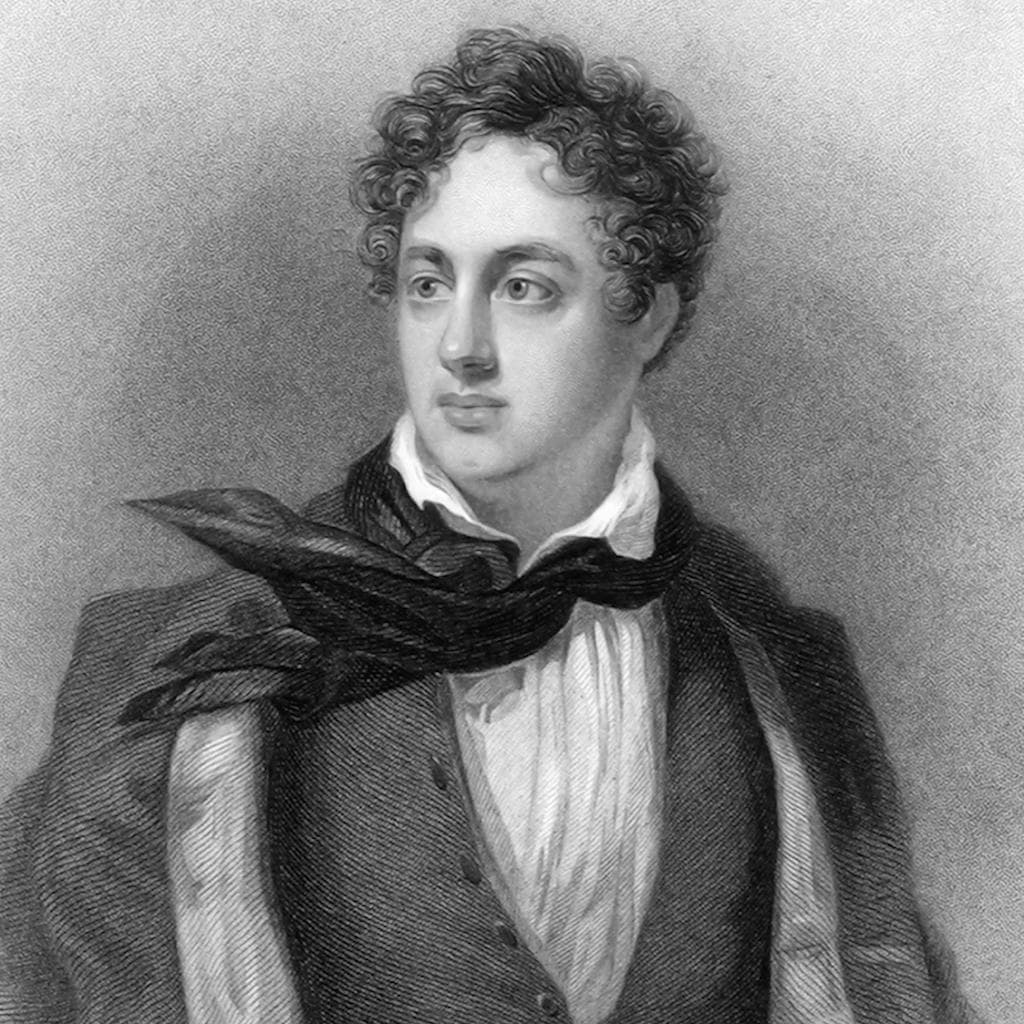
Be thou the rainbow in the storms of life. The evening beam that smiles the clouds away, and tints tomorrow with prophetic ray.

Lord Byron
"Mad, bad, and dangerous to know", George Gordon, Lord Byron (1788 - 1824), was the most flamboyant and notorious of the major Romantic poets. Lacking the inhibitions of his contemporaries, Byron's poetry is exuberant and spontaneous, causing him to be regarded still as one of the greatest of British poets.
George Gordon Byron was born on 22nd January 1788 in London, England. He was christened George Gordon Byron at St Marylebone Parish Church after his maternal grandfather, George Gordon of Gight, a descendant of King James I.
On 21 May 1798, the death of Byron’s great-uncle, the “wicked” Lord Byron, made the 10-year-old the 6th Baron Byron, and the young man inherited both title and estate, Newstead Abbey, in Nottinghamshire, England. Byron rarely lived at his estate, as the Abbey was rented to Lord Grey de Ruthyn, among others, during Byron’s adolescence.
In August 1799, Byron entered the school of William Glennie, an Aberdonian in Dulwich, but received his early formal education at Aberdeen Grammar School. In 1801 he was sent to Harrow, where he remained until July 1805. After leaving school he went on to Trinity College, Cambridge.
While not at school, Byron lived at Burgage Manor where, with the help of Elizabeth Pigot, was encouraged to write his first volumes of poetry –Â Hours of Idleness, which collected many of his previous poems, along with more recent compositions. The savage, anonymous criticism this received (now known to be the work of Henry Peter Brougham) in the Edinburgh Review prompted his first major satire, English Bardsand Scotch Reviewers (1809). The work so upset some of these critics they challenged Byron to a duel; over time, in subsequent editions, it became a mark of prestige to be the target of Byron’s pen.
In 1812, Byron embarked on a well-publicised affair with the married Lady Caroline Lamb that shocked the British public. Byron eventually broke off the relationship and moved swiftly on to others. Eventually Byron began to court Lady Caroline’s cousin Anne Isabella Milbanke (“Annabella”), who refused his first proposal of marriage but later accepted him. Milbanke was a highly moral woman, intelligent and mathematically gifted – she was also an heiress. They married at Seaham Hall, County Durham, on 2 January 1815. The marriage proved unhappy and on 16 January 1816, Lady Byron left him, taking their only child with her. After she left, Byron travelled to Europe and in Venice he wrote the fourth canto of Childe Harold. About the same time, he sold Newstead Abbey and published Manfred, Cain and The Deformed Transformed.
In 1824 he fell ill developing a violent fever, and died on 19 April. Amongst Byron’s best-known works are the brief poems She Walks in Beauty, When We Two Parted, and So, we’ll go no more a roving, in addition to the narrative poems Childe Harold’s Pilgrimage and Don Juan. He is regarded as one of the greatest British poets and remains widely read and influential. A collection of Byron’s work can be found here.
Essential cookies enable basic functions and are necessary for the proper function of the website.
Name
Description
Duration
Cookie Preferences
This cookie is used to store the user's cookie consent preferences.
30 days
These cookies are used for managing login functionality on this website.
Name
Description
Duration
wordpress_logged_in
Used to store logged-in users.
Persistent
wordpress_sec
Used to track the user across multiple sessions.
15 days
wordpress_test_cookie
Used to determine if cookies are enabled.
Session
Statistics cookies collect information anonymously. This information helps us understand how visitors use our website.
Track user interactions on your site with to optimize engagement and conversions.
Name
Description
Duration
_monsterinsights_uj
Stores anonymized user navigation history on the website, including visited URLs, page titles, and referrer information. It helps site owners analyze user journeys for improved site experience and analytics.
365 days
Marketing cookies are used to follow visitors to websites. The intention is to show ads that are relevant and engaging to the individual user.
Facebook Pixel is a web analytics service that tracks and reports website traffic.