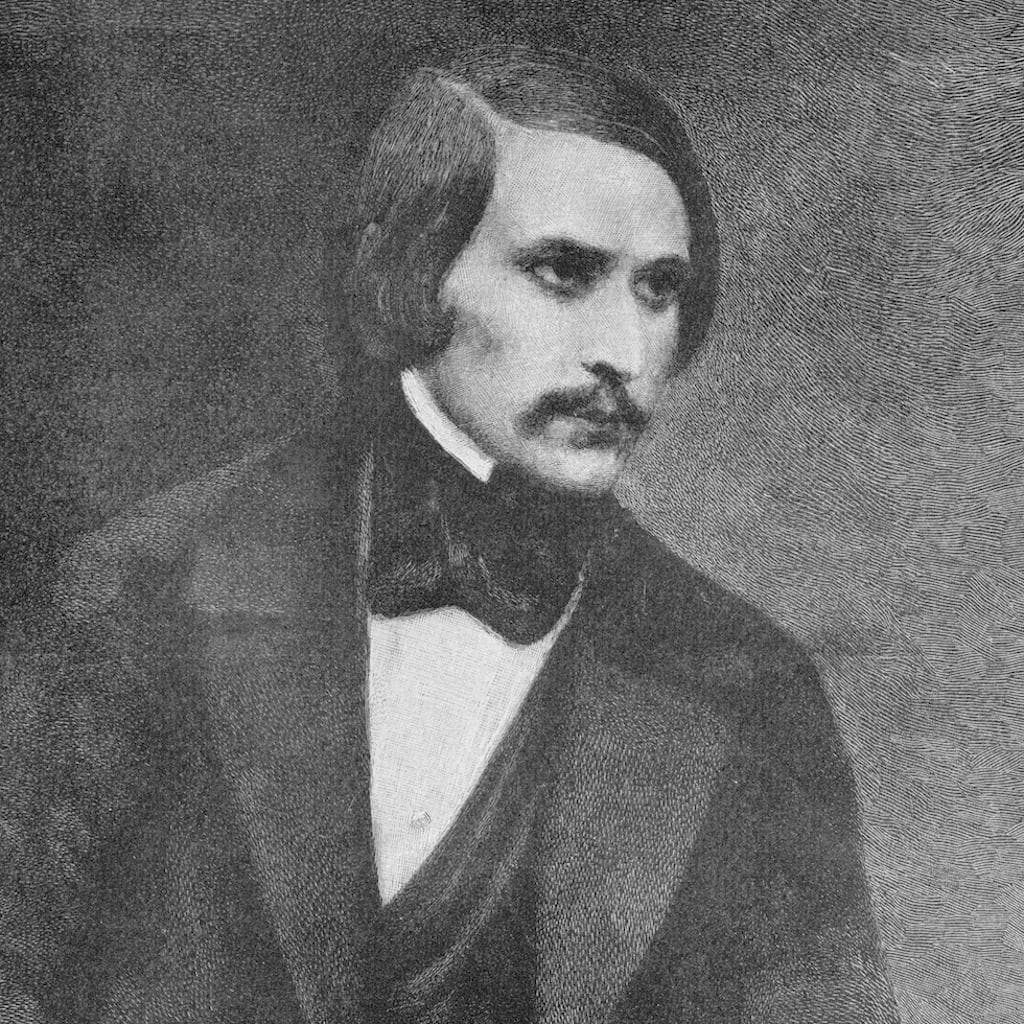
Countless as the sands of the sea are human passions.
Nikolai Gogol
Nikolay Vasilievich Gogol (1809 - 1852) was a Russian dramatist, novelist and short-story writer, whose satirical works on Russian life in general, and political corruption in particular eventually led to his exile. His best works, including 'Dead Souls' and 'The Nose', make him one of the funniest, yet profound, writers in literature.
Nikolai Gogol was born on 31st March 1809 in Sorochintsi, Ukraine. As a child he grew up on his parent’s country estate and in 1819 he began Poltava boarding school. After finishing high school in 1821 Gogol settled in St. Petersburg, supporting himself by working at minor governmental jobs and occasionally writing for periodicals.
He published his first poem in 1829, but this early narrative poem was ridiculed universally, leaving Gogol swearing never to write poetry again. In the years that followed he taught history at the Patrotic Institute and tutored in his spare time. In 1831 Gogol met Aleksandr Pushkin, a great romantic author and poet of the Romantic era, who greatly influenced Gogol’s works, particularly the first volume of his Ukrainian stories, Evenings on a Farm Near Dikanka. When the story was published in 1831 it was an instant success and soon after the works Mirgord and Arabesques were also published.
In 1836 Gogol published several stories in the journal, Sovremennik, and later that year performed in his comedy The Government Inspector, subsequently giving him hope to believe in his literary vocation. From 1836 to 1848 Gogol travelled abroad, staying in Germany, Switzerland and Paris where he frequently met the polish poets Adam Mickiewicz and Bohdan Zaleski.
In the latter years he settled in Rome where he fell in love with the nobleman Losif Vielhorski, this being the only documented love affair of his life. The death of Pushkin in 1837 devastated him, and while in Rome he wrote the satirical epic Dead Souls which appeared in Moscow in 1842 under the title The Adventures of Chichikov.
In 1848 Gogol made a pilgrimage to the Holy land. Upon his return to Russia he was afflicted by intense nervous depression and died on 21st February 1852. He was buried at the Danilov Monastery, close to his fellow Slavophile Aleksey Khomyakov.
Essential cookies enable basic functions and are necessary for the proper function of the website.
Name
Description
Duration
Cookie Preferences
This cookie is used to store the user's cookie consent preferences.
30 days
These cookies are used for managing login functionality on this website.
Name
Description
Duration
wordpress_logged_in
Used to store logged-in users.
Persistent
wordpress_sec
Used to track the user across multiple sessions.
15 days
wordpress_test_cookie
Used to determine if cookies are enabled.
Session
Statistics cookies collect information anonymously. This information helps us understand how visitors use our website.
Track user interactions on your site with to optimize engagement and conversions.
Name
Description
Duration
_monsterinsights_uj
Stores anonymized user navigation history on the website, including visited URLs, page titles, and referrer information. It helps site owners analyze user journeys for improved site experience and analytics.
365 days
Marketing cookies are used to follow visitors to websites. The intention is to show ads that are relevant and engaging to the individual user.
Facebook Pixel is a web analytics service that tracks and reports website traffic.