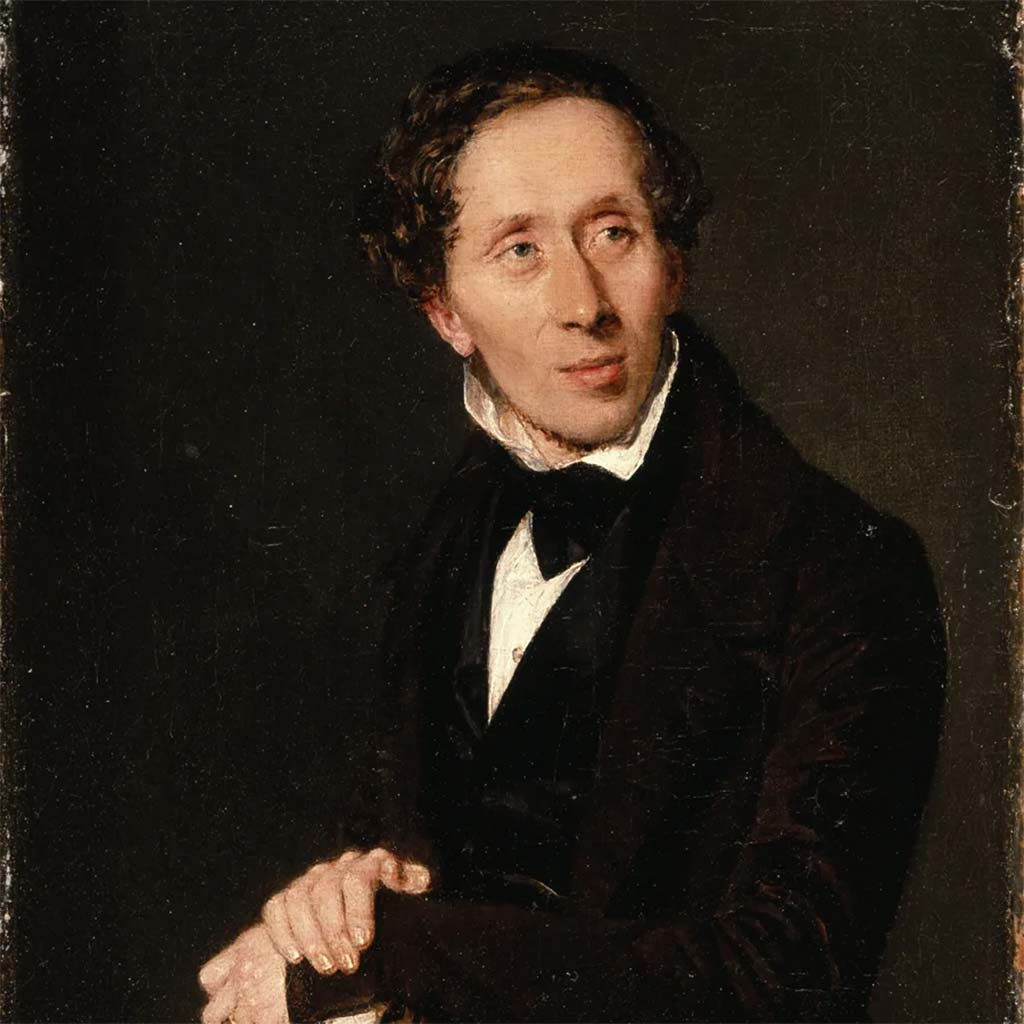
Everything you look at can become a fairy tale and you can get a story from everything you touch

Hans Christian Andersen
Few writers are as universally popular as Hans Christian Andersen (1805-1875). Using experiences from his own rather lonely life, he invented a form of fairy tales that was uniquely his, and which have been translated into over 150 languages.
Hans Christian Andersen was born in the town of Odense, Denmark, on Tuesday, April 2nd, 1805. His father, Hans Andersen, was an indigent shoemaker who believed he was of aristocratic origin. Andersen’s mother, Anne Marie Andersdatter, worked as a washerwoman. Although she was uneducated and superstitious, she opened the world of folklore to their son.
Andersen received little education. As a child he was highly emotional, suffering all kinds of fears and humiliations because of his tallness and effeminate interests. Encouraged by his parents, he composed his own fairy tales and arrange puppet theatre shows. His father loved literature and often took Andersen to the playhouse.
In 1816 his father died and Andersen was forced to go to work. For a short time, he was apprenticed to a weaver and tailor and also worked at a tobacco factory. In 1822 Jonas Collin, one of the directors of the Royal Theatre and an influential government official gave Andersen a grant to enter the grammar school at Slagelse. He lived in the home of the school headmaster Meisling, who was irritated by the oversensitive student and tried to harden his character.
In 1829, Andersen enjoyed considerable success with a short story entitled A Journey on Foot from Holmen’s Canal to the East Point of Amager. In the same year, he also published a comedy and a collection of poems. Though he made little progress writing and publishing immediately thereafter, in 1833 he received a small travelling grant from the King, enabling him to set out on the first of his many journeys through Europe.
It was during 1835 that Andersen published the first instalment of his famous Fairy Tales. More stories, completing the first volume, were published in 1836 and 1837. With these collections, inspired by the great tradition of the Arabian Nights, and Household Tales, collected by the Brothers Grimm, Andersen became known as the father of the modern fairytale.
Andersen’s identification with the unfortunate and outcast made his tales compelling. Some of Andersen’s tales revealed an optimistic belief in the triumph of the good, among them The Snow Queen and Little Ugly Duckling. Some ended unhappily, like The Little Match Girl. Andersen died in his home in Rolighed on 4th August 1875.
Additional resources about Hans Christian Andersen.
Essential cookies enable basic functions and are necessary for the proper function of the website.
Name
Description
Duration
Cookie Preferences
This cookie is used to store the user's cookie consent preferences.
30 days
These cookies are used for managing login functionality on this website.
Name
Description
Duration
wordpress_logged_in
Used to store logged-in users.
Persistent
wordpress_sec
Used to track the user across multiple sessions.
15 days
wordpress_test_cookie
Used to determine if cookies are enabled.
Session
Statistics cookies collect information anonymously. This information helps us understand how visitors use our website.
Track user interactions on your site with to optimize engagement and conversions.
Name
Description
Duration
_monsterinsights_uj
Stores anonymized user navigation history on the website, including visited URLs, page titles, and referrer information. It helps site owners analyze user journeys for improved site experience and analytics.
365 days
Marketing cookies are used to follow visitors to websites. The intention is to show ads that are relevant and engaging to the individual user.
Facebook Pixel is a web analytics service that tracks and reports website traffic.