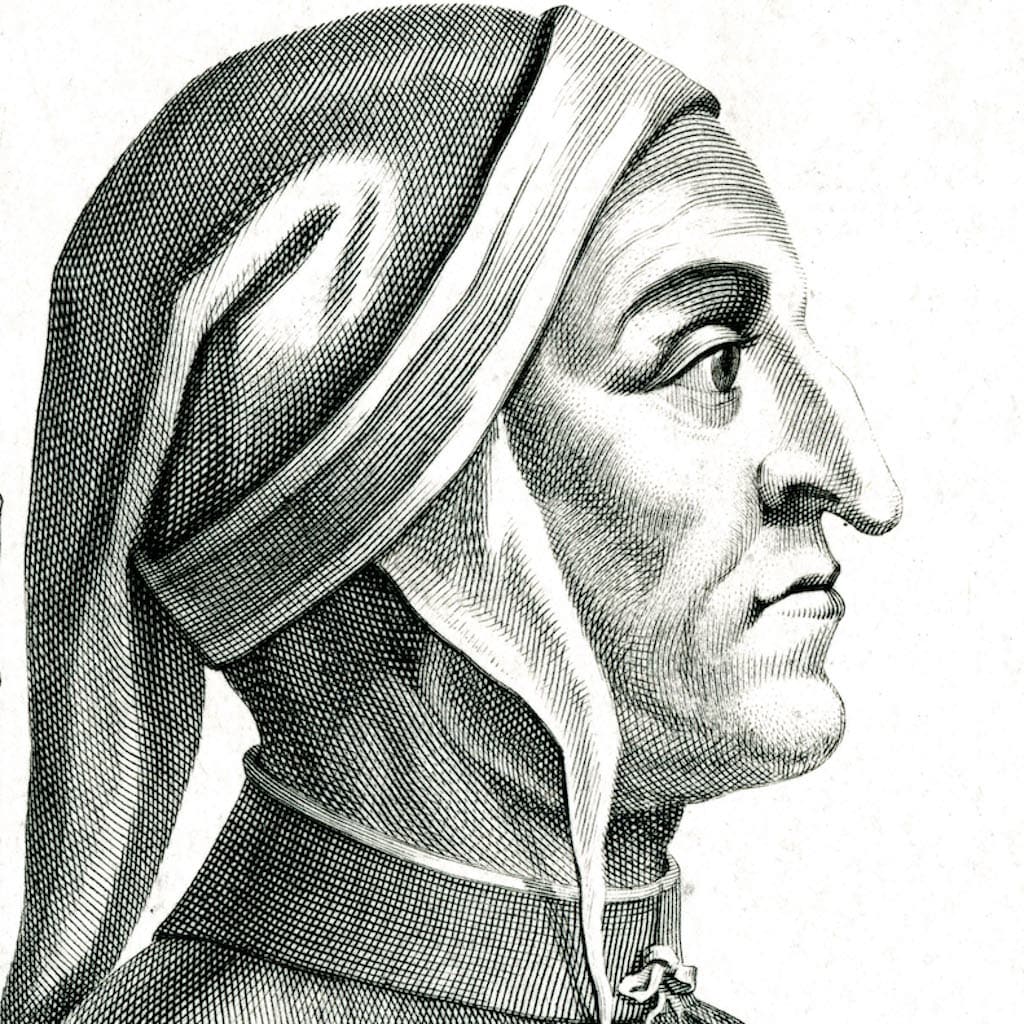
Dante Alighieri (1265? - 1321) is considered the finest poet that Italy has ever produced, and is also celebrated as a major influence on western European culture through his major work, 'The Divine Comedy'.
The exact date of Dante’s birth is not known, although it is generally believed to be around 1265. This can be deduced from autobiographic allusions in La Divina Commedia (The Divine Comedy), and The Inferno (“Halfway through the journey we are living”, implying that Dante was around 35 years old, as the average lifespan according to the Bible (Psalms 89:10, Vulgate) is 70 years, and as the imaginary travel took place in 1300 Dante must have been born around 1265).
Dante claimed that his family descended from the ancient Romans (Inferno, XV, 76), but the earliest relative he could mention by name was Cacciaguida degli Elisei (Paradiso, XV, 135), of no earlier than about 1100. Dante’s father, Alighiero di Bellincione, was a White Guelph who suffered no reprisals after the Ghibellines won the Battle of Montaperti in the mid 13th century. This suggests that Alighiero or his family enjoyed some protective prestige and status. Dante’s family was prominent in Florence, with loyalties to the Guelphs, a political alliance that supported the Papacy and which was involved in complex opposition to the Ghibellines, who were backed by the Holy Roman Emperor. The poet’s mother was Bella degli Abati. She died when Dante was not yet ten years old, and Alighiero soon married again, to Lapa di Chiarissimo Cialuffi. It is uncertain whether they were legally married, as widowers had social limitations in these matters But his new ‘wife’ definitely bore two children, Dante’s brother Francesco and sister Tana (Gaetana).
When Dante was 12, he was promised in marriage to Gemma di Manetto Donati, daughter of Messer (Sir) Manetto Donati. Contracting marriages at this early age was quite common and involved a formal ceremony, including contracts signed before a notary. Dante had already fallen in love with another woman, Beatrice Portinari (known also as Bice). Years after his marriage to Gemma, he met Beatrice again. He had become interested in writing verse, and although he wrote several sonnets to Beatrice, he never mentioned his wife Gemma in any of his poems. Dante had several children with Gemma. As often happens with significant figures, many people subsequently claimed to be Dante’s offspring. However, it is likely that Jacopo, Pietro, Giovanni and Antonia were truly his children. Antonia became a nun with the name of Sister Beatrice.
Some fifty poetical components by Dante are known (the so-called Rime, rhymes), others being included in the later Vita Nuova and Convivio. Other studies are reported, or deduced from Vita Nuova or the Comedy, regarding painting and music. Dante died on 14th September 1321 around the age of 56.
Essential cookies enable basic functions and are necessary for the proper function of the website.
Name
Description
Duration
Cookie Preferences
This cookie is used to store the user's cookie consent preferences.
30 days
These cookies are used for managing login functionality on this website.
Name
Description
Duration
wordpress_logged_in
Used to store logged-in users.
Persistent
wordpress_sec
Used to track the user across multiple sessions.
15 days
wordpress_test_cookie
Used to determine if cookies are enabled.
Session
Statistics cookies collect information anonymously. This information helps us understand how visitors use our website.
Track user interactions on your site with to optimize engagement and conversions.
Name
Description
Duration
_monsterinsights_uj
Stores anonymized user navigation history on the website, including visited URLs, page titles, and referrer information. It helps site owners analyze user journeys for improved site experience and analytics.
365 days
Marketing cookies are used to follow visitors to websites. The intention is to show ads that are relevant and engaging to the individual user.
Facebook Pixel is a web analytics service that tracks and reports website traffic.