
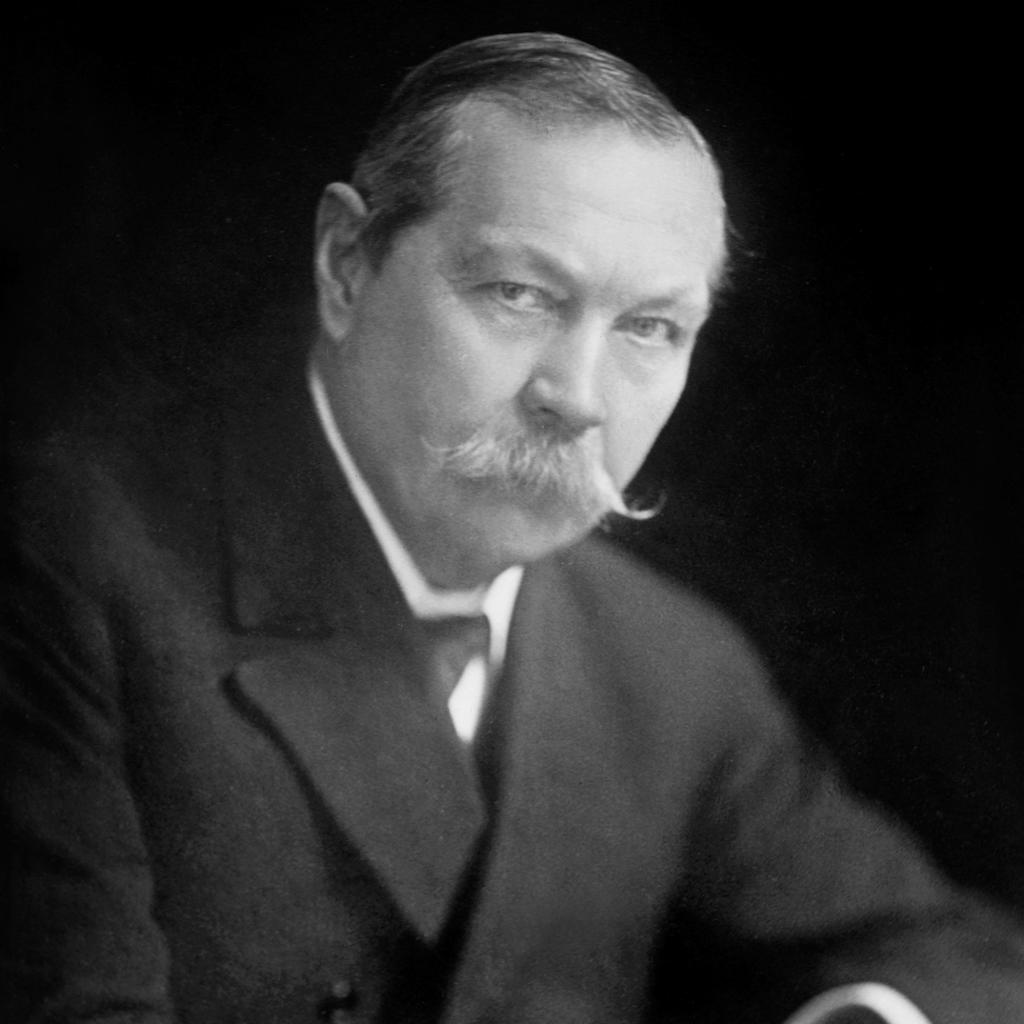
When you have eliminated the impossible, whatever remains, however improbable, must be the truth.
Sir Arthur Conan Doyle
Sir Arthur Conan Doyle (1859-1930) was a Scottish physician and writer. His works encompass a wide variety of genres, and it was his historical novels that he considered his finest work. However, posterity remembers him only as the creator of Sherlock Holmes. Each new generation discovers Holmes afresh, as the current TV and film adaptations demonstrate. Doyle created a character so well known that he exists in the borderline between fiction and reality.
To read David Stuart Davies’ article regarding the continuing appeal of Sherlock Holmes, click here.
Arthur Conan Doyle was born in Edinburgh in 1859, the son of Charles Altamont Doyle and Mary (Foley) Doyle, both practising Roman Catholics. In order to supplement his income (he was an unsuccessful architect) his father painted and made illustrated books. Doyle attended the Jesuit Stonyhurst College but had abandoned his family’s Catholicism by the time he had completed his medical studies at Edinburgh University. In 1884 he married Louise Hawkins and qualified as a doctor in 1885 after which he practised as an eye specialist near Portsmouth until 1891, when he became a full-time writer. His father died in an asylum in 1893 after being institutionalized for some years.
The first Sherlock Holmes story, A Study in Scarlet, was written in 1886 over a three week period and published a year later. This was followed by a second novel, The Sign of the Four (1890), and the first collection of short stories, The Adventures of Sherlock Holmes (1892), all of which were first published in the Strand Magazine. Despite the huge popularity of the Holmes stories, Doyle felt they detracted from his other, more serious writing, so in the last story of The Memoirs of Sherlock Holmes (1894) ‘The Final Problem’, Doyle killed off Holmes in a final, fatal confrontation with the arch-villain, Professor Moriarty.
There was a huge public reaction, with 20,000 subscriptions to the Strand magazine cancelled, but Doyle resisted the pressure to bring back his finest creation until 1902, when he released The Hound of the Baskervilles, a full-length novel set earlier in Holmes’ career. Finally, in ‘The Empty Room’, the first story in The Return of Sherlock Holmes, he restored Holmes to life. Further stories appeared sporadically. The Valley of Fear, a novel in 1915, and two further collections of stories, His Last Bow (1917) and The Casebook of Sherlock Holmes (1927).
Doyle served as a physician during the Boer War, and defended England’s policy in The War in South Africa. As well as the ‘Holmes’ stories he wrote a series of notable historical romances as well as the popular ‘Professor Challenger Stories’ published as, The Lost World (1912), The Poison Belt (1913), The Land of Mist (1926), When The World Screamed (1928) and The Disintegration Machine (1929). He was fine writer of ghost stories, as shown in the collection of stories published as Tales of Unease.
He was knighted in 1902 and ran unsuccessfully for parliament. His wife, Louise, died in 1906, after a long illness. In 1907, he married his second wife, Jean Leckie. In later years he turned to spiritualism and devoted much of his energy to promoting and writing on the subject. His last book The Edge of the Unknown (1930) recorded his own psychic experiences.
He died from heart disease on the 7th July, 1930 at his home in Windlesham, Sussex.
Essential cookies enable basic functions and are necessary for the proper function of the website.
Name
Description
Duration
Cookie Preferences
This cookie is used to store the user's cookie consent preferences.
30 days
These cookies are used for managing login functionality on this website.
Name
Description
Duration
wordpress_logged_in
Used to store logged-in users.
Persistent
wordpress_sec
Used to track the user across multiple sessions.
15 days
wordpress_test_cookie
Used to determine if cookies are enabled.
Session
Statistics cookies collect information anonymously. This information helps us understand how visitors use our website.
Track user interactions on your site with to optimize engagement and conversions.
Name
Description
Duration
_monsterinsights_uj
Stores anonymized user navigation history on the website, including visited URLs, page titles, and referrer information. It helps site owners analyze user journeys for improved site experience and analytics.
365 days
Marketing cookies are used to follow visitors to websites. The intention is to show ads that are relevant and engaging to the individual user.
Facebook Pixel is a web analytics service that tracks and reports website traffic.