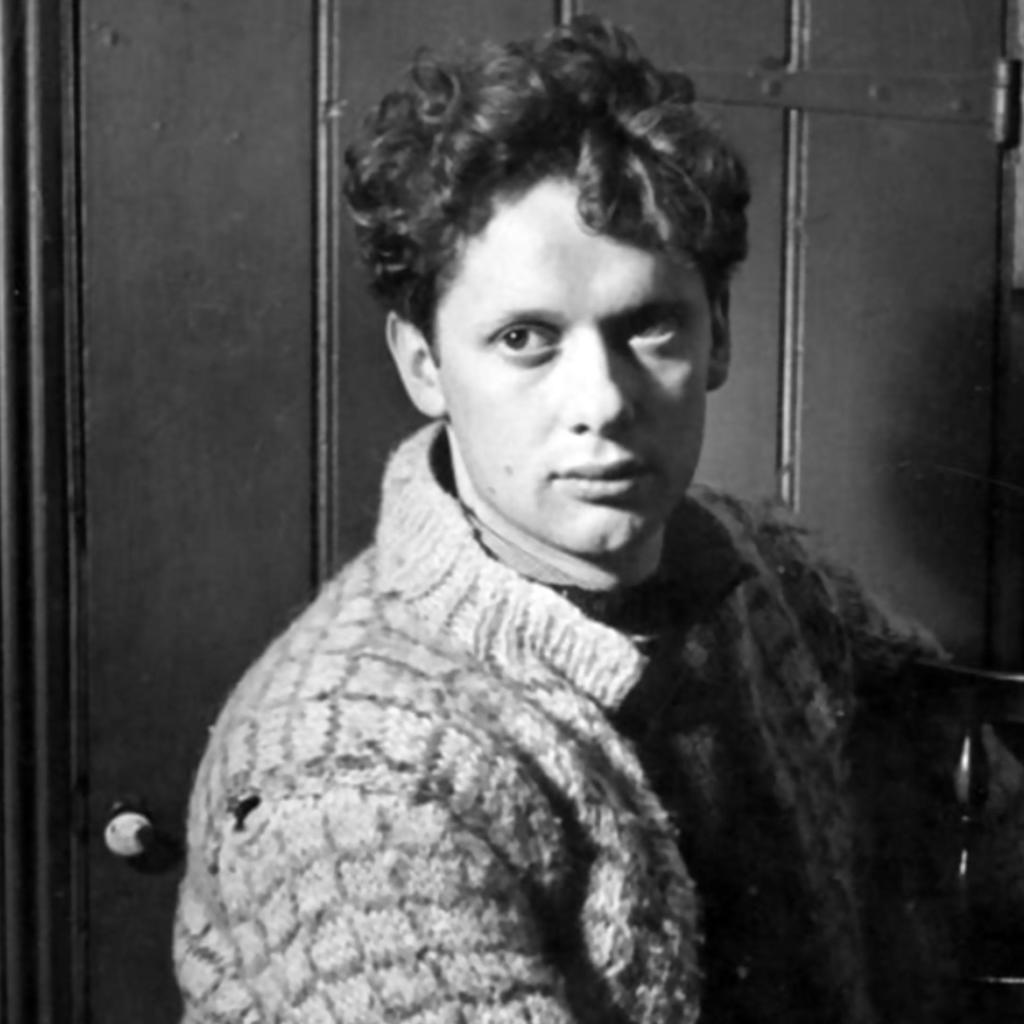
Do not go gentle into that good night, Old age should burn and rave at close of day; Rage, rage against the dying of the light.

Dylan Thomas
Dylan Marlais Thomas (1914-1953) was foremost a poet, but also a short story writer, playwright, radio broadcaster and non-fiction writer. Given the brevity of his life – he died aged 39 – he produced a remarkable number and range of important twentieth-century works, including the radio play Under Milk Wood, the short story collection Portrait of the Artist as a Young Dog, much-loved autobiographical pieces such as ‘A Child’s Christmas in Wales’, and a substantial Collected Poems including several popular classics, such as ‘Do not go gentle into that good night’, ‘Fern Hill’, and ‘The force that through the green fuse drives the flower’.
Dylan Thomas’s early home life was comfortable. His mother was, according to his first biographer Paul Ferris, ‘warm and affectionate’. His father was the English master at Swansea Grammar School and had a considerable library which Dylan drew on. First Cwmdonkin Park next to his home, and then Swansea itself and its environs, were his playgrounds. He attended the Grammar School, but his interest already lay in writing and he didn’t pursue his studies, other than literature. His first poem for the school magazine was written in 1925 when he was 11; he began the first of his Poetry Notebooks, where he transcribed what he regarded as finished work, in 1930 at the age of 15. He formed a small, close group of friends at this time, including Daniel Jones who was to become a considerable composer.  At 16 he left school and became a reporter on the South Wales Evening Post; much of his experience during this period forms the basis of the stories in Portrait. With other friends he formed the Kardomah Gang which met at the coffee house of that name for cultural discussions.
Thomas continued to record his poetic output in four Notebooks spanning 1930 to early 1934, and he drew on the 1933-34 work substantially for his first published poems and collections. He had a dramatic success when he was only 18, publishing his first poem in a London periodical, the remarkably mature ‘And death shall have no dominion’, and moved to London in late 1934. He was also writing short stories and had considerable success placing both poems and stories in the main literary periodicals of the time, including Criterion (edited by T. S. Eliot), the Adelphi, and New Verse, in the latter being published alongside established poets such as Louis MacNeice, W. H. Auden and William Carlos Williams. In December 1934, his first collection of poems, 18 Poems was published (he was then aged just 20). In 1935 he met the poet Vernon Watkins in Swansea; they became close friends, exchanged ideas about poetry and commented on each other’s nascent poems. Watkins was a sympathetic but usefully critical reader of Thomas’s draft poems. In September 1936 his second collection, Twenty-Five Poems, was published. He was thus an established and well-recognised poet by the time he met Caitlin Macnamara in April 1936. They were married in July 1937 and went to live in Laugharne, Carmarthenshire in 1938. In 1939, in the space of a year, his first child Llewelyn was born, his mixed-genre collection of short stories and poems, The Map of Love was published, and he had his first publication in America, The World I Breathe, containing poems and stories.
This pre-war time was a fertile creative period for him; he was writing and publishing individually the stories that would go to make up the collection, Portrait of the Artist as a Young Dog, published April 1940. As the Second World War approached, he made clear in many of his personal letters that he had no wish to fight, but neither did he want to make a conscientious objection; he felt that by pursuing his writing he was doing his duty. He was eventually classified Grade 3 and never called up. During the war he worked as a scriptwriter and producer for Strand Films, on documentaries and Ministry of Information films, scripting 23 films in 6 years. Hack work in one sense, it provided superb experience which he undoubtedly drew on for the later Under Milk Wood, and possibly for his wartime poems too. In 1943 he began to broadcast regularly for the BBC, at a time when many literary figures were working there. This was a difficult climate for his own creative work and for his recent publications. He, Caitlin and Llewelyn had a peripatetic existence between London and Wales; a second child, Aeronwy, was born in 1943. They were chronically short of money. In 1944-45 they lived in the fishing village of New Quay on the Cardiganshire coast (this along with Laugharne formed the inspiration for Under Milk Wood and the fictional village of Llareggub).
In spite of the demands and difficulties of this period, in both the opening and the closing stages of the war Thomas produced some of his best poetic work, public poems inspired by common experiences of death on the Home Front, such as ‘A Refusal to Mourn the Death, by Fire, of a Child in London’, personal poems which went back to the idyll of his youth, such as ‘Fern Hill’, and a powerful reflection on his own work as a poet, ‘In my craft and sullen art’. All three, and several other ‘war’ poems, would be included in Deaths and Entrances, his post-war collection, 1946.
In 1949, Thomas and his family moved back to Laugharne, and their third child Colm was born there in the same year. Here they lived in The Boat House where his writing hut has since been immortalized and is kept as a sort of living museum to his work, though in fact he wrote a relatively small amount of his whole output there. But it was there that first versions of Under Milk Wood and his last few poems were written, along with the supervision of his Collected Poems, 1934-1952. Under Milk Wood had a long gestation, traceable right back to his schoolboy days, and it pops its head up as an idea at various points, including in 1939 as ‘a play about well-known Laugharne characters’. In 1950 he sent the first half of it to the BBC, and in 1951 he was developing it further as, in his words, ‘a piece, a play, an impression for voices, an entertainment out of the darkness’. It was his abiding writing interest in these last years.
From 1950 to 1953 Dylan Thomas’s life was a welter of travel, activity, profound experiences, and writing and performance demands: tours to America (four, all with punishing schedules), the preparation and publication of the summative Collected Poems (November 1952), the death of his father (December 1952), the death of his sister (1953), the final revisions of Under Milk Wood, and upheavals in his married and personal life. All the while he was drinking very heavily, as he always had. The culmination came on his final American tour which started in October 1953. A version of Under Milk Wood had been finished and performed in May 1953 on the previous tour (recorded by Caedmon records, with Dylan Thomas as First Voice). A further version was performed on this last tour, Thomas again taking part. There are variable accounts of his end, but he was admitted to St Vincent’s Hospital in New York in a coma on November 5 1953, and never regained consciousness. He died on November 9th and was buried on November 24 1953 at Laugharne.
Under Milk Wood received its first performance on BBC radio in January 1954 with Richard Burton as First Voice, and it was published soon afterwards. It has never been out of print. In 1982 a Memorial Stone was unveiled to Dylan Thomas in Poet’s Corner, Westminster Abbey.
Paul Ferris, Dylan Thomas: a biography, The Dial Press, New York, 1977
Andrew Lycett, Dylan Thomas: A New Life, Weidenfeld and Nicolson, London, 2003
Dylan Thomas: A Centenary Celebration, edited by Hannah Ellis, the granddaughter of Dylan and Caitlin Thomas; Bloomsbury, London, 1914
Dylan Thomas: The Caedmon Collection, Caedmon, 2004: a wide range of archival recordings, including the first performance of Under Milk Wood in New York, with Dylan Thomas as First Voice, and many recordings of Thomas reading his own poems, and those of others, and his BBC broadcasts.
Essential cookies enable basic functions and are necessary for the proper function of the website.
Name
Description
Duration
Cookie Preferences
This cookie is used to store the user's cookie consent preferences.
30 days
These cookies are used for managing login functionality on this website.
Name
Description
Duration
wordpress_logged_in
Used to store logged-in users.
Persistent
wordpress_sec
Used to track the user across multiple sessions.
15 days
wordpress_test_cookie
Used to determine if cookies are enabled.
Session
Statistics cookies collect information anonymously. This information helps us understand how visitors use our website.
Track user interactions on your site with to optimize engagement and conversions.
Name
Description
Duration
_monsterinsights_uj
Stores anonymized user navigation history on the website, including visited URLs, page titles, and referrer information. It helps site owners analyze user journeys for improved site experience and analytics.
365 days
Marketing cookies are used to follow visitors to websites. The intention is to show ads that are relevant and engaging to the individual user.
Facebook Pixel is a web analytics service that tracks and reports website traffic.