
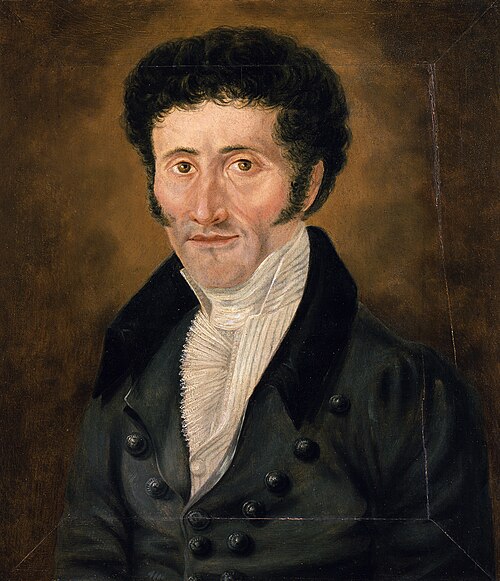
“Why should not a writer be permitted to make use of the levers of fear, terror and horror because some feeble soul here and there finds it more than it can bear? Shall there be no strong meat at table because there happen to be some guests there whose stomachs are weak, or who have spoiled their own digestions?”
Hoffmann’s stories highly influenced 19th-century literature, and he is one of the major authors of the Romantic movement.[5]
Hoffmann’s ancestors, both maternal and paternal, were jurists.[6] His father, Christoph Ludwig Hoffmann (1736–97), was a barrister in Königsberg, Prussia (now Kaliningrad, Russia), as well as a poet and amateur musician who played the viola da gamba. In 1767 he married his cousin, Lovisa Albertina Doerffer (1748–96). Ernst Theodor Wilhelm, born on 24 January 1776, was the youngest of three children, of whom the second died in infancy.
When his parents separated in 1778, his father went to Insterburg (now Chernyakhovsk) with his elder son, Johann Ludwig Hoffmann (1768–1822), while Hoffmann’s mother stayed in Königsberg with her relatives: two aunts, Johanna Sophie Doerffer (1745–1803) and Charlotte Wilhelmine Doerffer (c. 1754–79) and their brother, Otto Wilhelm Doerffer (1741–1811), who were all unmarried. The trio raised the youngster.
The household, dominated by the uncle (whom Ernst nicknamed O Weh—”Oh dear!”—in a play on his initials “O.W.”), was pietistic and uncongenial. Hoffmann was to regret his estrangement from his father. Nevertheless, he remembered his aunts with great affection, especially the younger, Charlotte, whom he nicknamed Tante Füßchen (“Aunt Tootsy-Wootsy”). Although she died when he was only three years old, he treasured her memory (a character in Hoffmann’s Lebensansichten des Katers Murr is named after her) and embroidered stories about her to such an extent that later biographers sometimes assumed her to be imaginary, until proof of her existence was found after World War II.[7]
Between 1781 and 1792 he attended the Lutheran school or Burgschule, where he made good progress in classics. Ernst showed great talent for piano-playing, and busied himself with writing and drawing. The provincial setting was not, however, conducive to technical progress, and despite his many-sided talents he remained rather ignorant of both classical forms and of the new artistic ideas that were developing in Germany. He had, however, read Schiller, Goethe, Swift, Sterne, Rousseau and Jean Paul, and wrote part of a novel titled Der Geheimnisvolle.
In 1794, Hoffmann became enamored of Dora Hatt, a married woman to whom he had given music lessons. She was ten years older, and gave birth to her sixth child in 1795.[8] In February 1796, her family protested against his attentions and, with his hesitant consent, asked another of his uncles to arrange employment for him in Glogau (Głogów), Prussian Silesia.[9]
Essential cookies enable basic functions and are necessary for the proper function of the website.
Name
Description
Duration
Cookie Preferences
This cookie is used to store the user's cookie consent preferences.
30 days
These cookies are used for managing login functionality on this website.
Name
Description
Duration
wordpress_logged_in
Used to store logged-in users.
Persistent
wordpress_sec
Used to track the user across multiple sessions.
15 days
wordpress_test_cookie
Used to determine if cookies are enabled.
Session
Statistics cookies collect information anonymously. This information helps us understand how visitors use our website.
Track user interactions on your site with to optimize engagement and conversions.
Name
Description
Duration
_monsterinsights_uj
Stores anonymized user navigation history on the website, including visited URLs, page titles, and referrer information. It helps site owners analyze user journeys for improved site experience and analytics.
365 days
Marketing cookies are used to follow visitors to websites. The intention is to show ads that are relevant and engaging to the individual user.
Facebook Pixel is a web analytics service that tracks and reports website traffic.