A propensity to hope and joy is real riches; one to fear and sorrow real poverty.

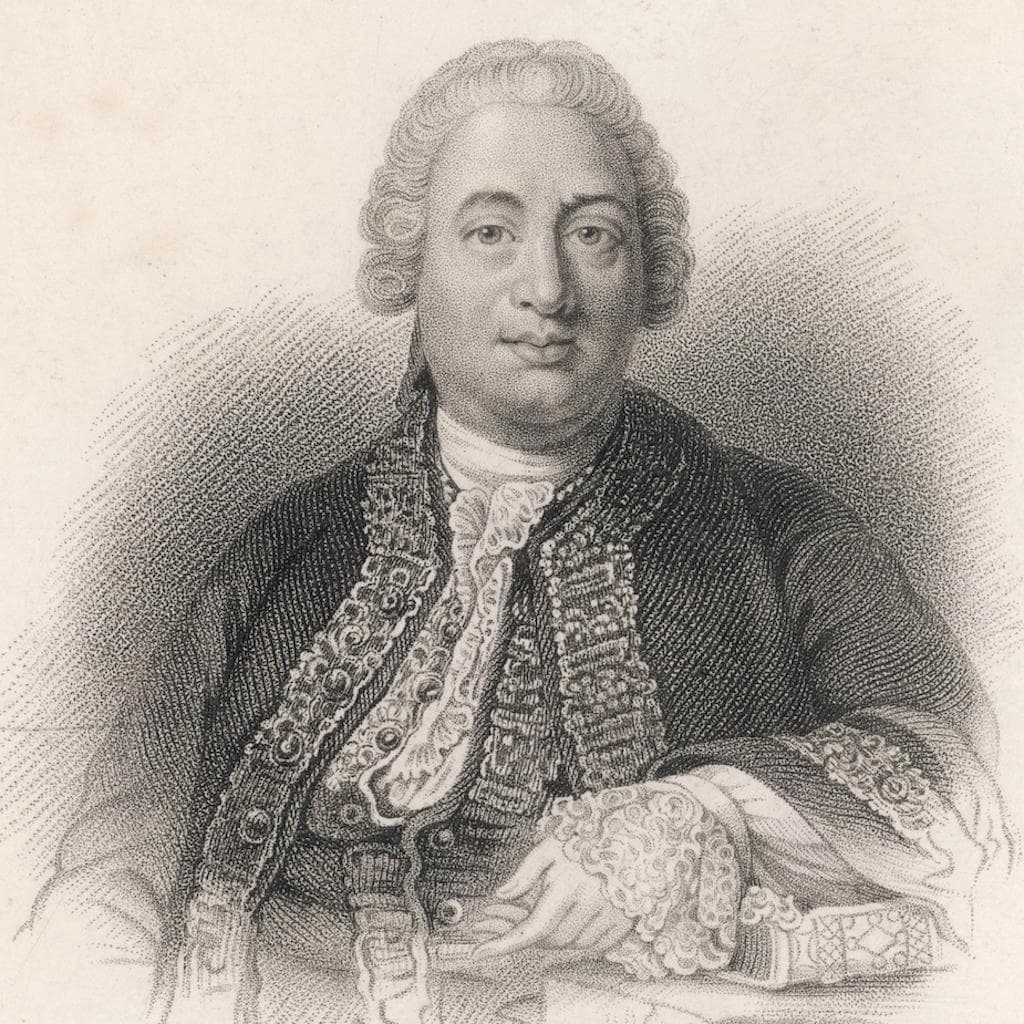
David Hume
David Hume (1711-1776) is one of the most important British philosophers, essayists, and historians of the eighteenth century. Hume’s works, controversial in his day, remain deeply and widely influential in ours, especially for his contributions to our understanding of the nature of morality, political and economic theory, philosophy of religion, and philosophical naturalism.
David Home was born in Edinburgh on 26 April 1711. He changed his surname to Hume in 1734 because the English had difficulty pronouncing ‘Home’ in the Scottish manner.
Hume attended the University of Edinburgh at the unusually early age of twelve (possibly, even as young as ten), when fourteen was the normal age. He had little respect for the professors at the university, telling a friend in 1735, “there is nothing to be learnt from a Professor, which is not to be met with in Books”.
Hume’s need to make a living was to result in several attempted careers and a variety of short-term employments. In his early life, his options lay between a travelling tutorship and a stool in a merchant’s office. He chose the latter and in 1734 he went to La Flèche, in Anjou, France. During his time in France, 26 year old Hume completed A Treatise of Human Nature.
Although many scholars today consider the Treatise to be his most important work and one of the most important books in Western philosophy, the critics in Great Britain at the time did not agree, describing it as “abstract and unintelligible”. Hume – The Essential Philosophical Works is published by Wordsworth Editions.
He died on 25 August 1776, probably of either bowel or liver cancer. The author James Boswell saw Hume a few weeks before his death. Hume told him he sincerely believed it a “most unreasonable fancy” that there might be life after death. Hume asked that he be interred in a “simple roman tomb”, which, in his will, he wishes to be inscribed only with his name and the year of his birth and death, “leaving it to Posterity to add the Rest.” It stands, as he wished it, on the southwestern slope of Calton Hill, in the Old Calton Cemetery, Edinburgh, not far from his New Town home.
Essential cookies enable basic functions and are necessary for the proper function of the website.
Name
Description
Duration
Cookie Preferences
This cookie is used to store the user's cookie consent preferences.
30 days
These cookies are used for managing login functionality on this website.
Name
Description
Duration
wordpress_logged_in
Used to store logged-in users.
Persistent
wordpress_sec
Used to track the user across multiple sessions.
15 days
wordpress_test_cookie
Used to determine if cookies are enabled.
Session
Statistics cookies collect information anonymously. This information helps us understand how visitors use our website.
Track user interactions on your site with to optimize engagement and conversions.
Name
Description
Duration
_monsterinsights_uj
Stores anonymized user navigation history on the website, including visited URLs, page titles, and referrer information. It helps site owners analyze user journeys for improved site experience and analytics.
365 days
Marketing cookies are used to follow visitors to websites. The intention is to show ads that are relevant and engaging to the individual user.
Facebook Pixel is a web analytics service that tracks and reports website traffic.